

Long layovers either feel like dead time or a bonus destination, and Zurich definitely fell into the bonus category. With about seven hours between flights, we made the quick 15 minute train ride from the airport into the center of the city. Add the fact that it was Christmas season, and suddenly Zurich was not just a stopover, it was a festive, sparkling detour wrapped in lights and mulled wine aromas.
Zurich in December feels like a curated holiday postcard. Every square has its own personality, every corner glows, and every alley smells faintly of roasted nuts or fresh pastries. Even if you only have a few hours, the city makes it easy to step into its history, architecture, and winter magic.
Below is how we spent our layover exploring Old Town and sampling some of the city’s most charming Christmas markets.
Zentralbibliothek Zürich
We began with a walk through the quiet university quarter to Zentralbibliothek Zürich, the main library serving both the city and the canton. The approach itself sets the tone for the Old Town experience, with narrow stone paths and historic façades creating a calm, academic atmosphere before the busier pedestrian streets unfold below.
Hirschen-Platz and Grimmenturm
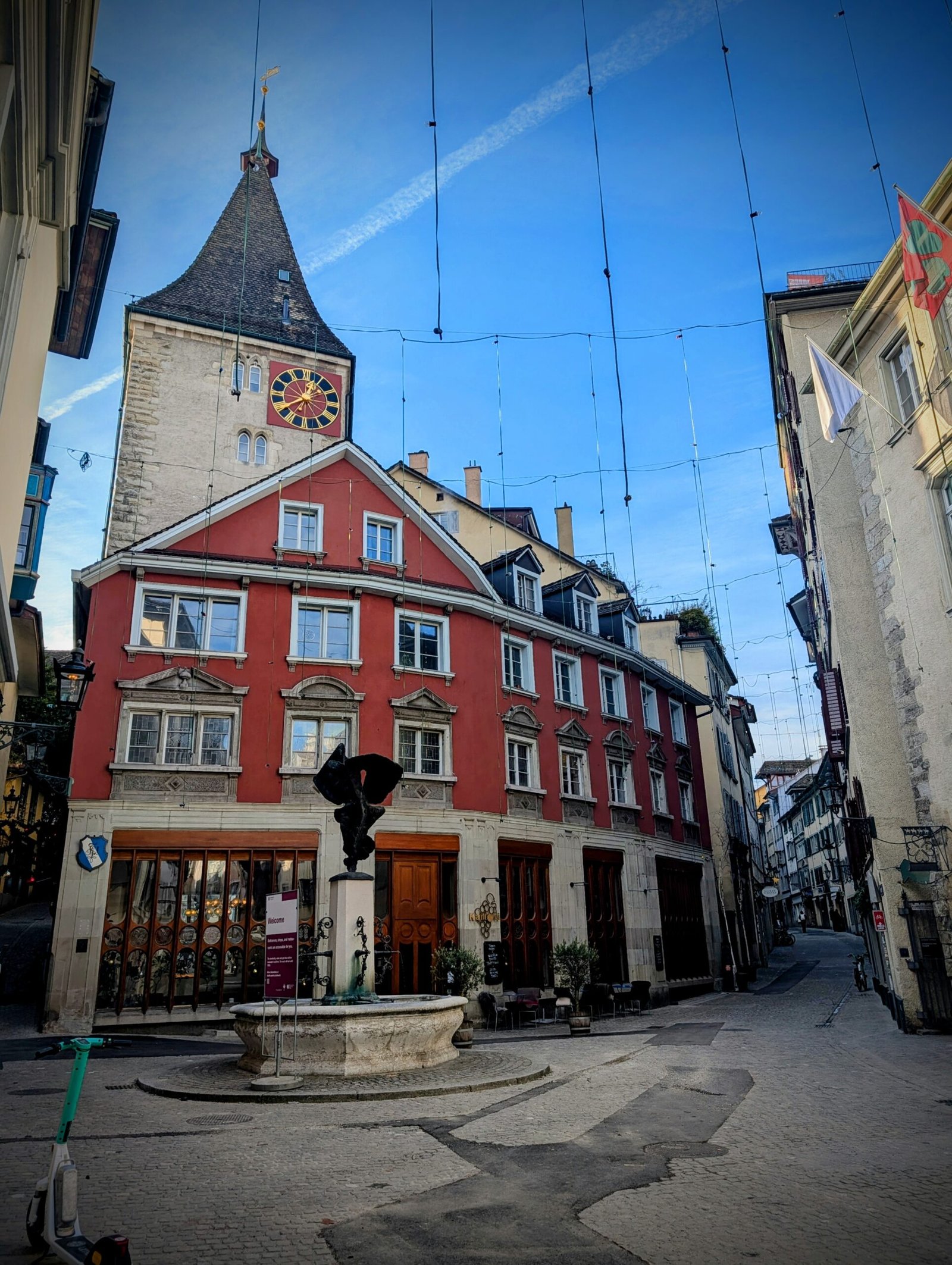
From the library we made our way into Hirschen-Platz, one of those quintessential Old Town squares where every building looks like it has a story. A few steps away is Grimmenturm, a 13th century tower that once belonged to a noble family. Today it houses a restaurant, but even from the outside, its medieval stone exterior offers a clear window into Zurich’s past.
Chimney Cakes
We walked past Toth’s, one of the well known chimney cake bakeries in the city, although it was not open yet when we arrived. Thankfully, we found chimney cake later at a Christmas market kiosk, warm, rolled in sugar, and absolutely worth the wait.
Leninwohnung
Zurich has its share of unexpected historical footnotes, and one of them is the Leninwohnung, the apartment where Vladimir Lenin lived in exile during 1916 and 1917. A simple plaque marks the site, a surprising touchpoint of global history in the middle of a quiet neighborhood.
Napfbrunnen and Zurich’s Historic Fountains
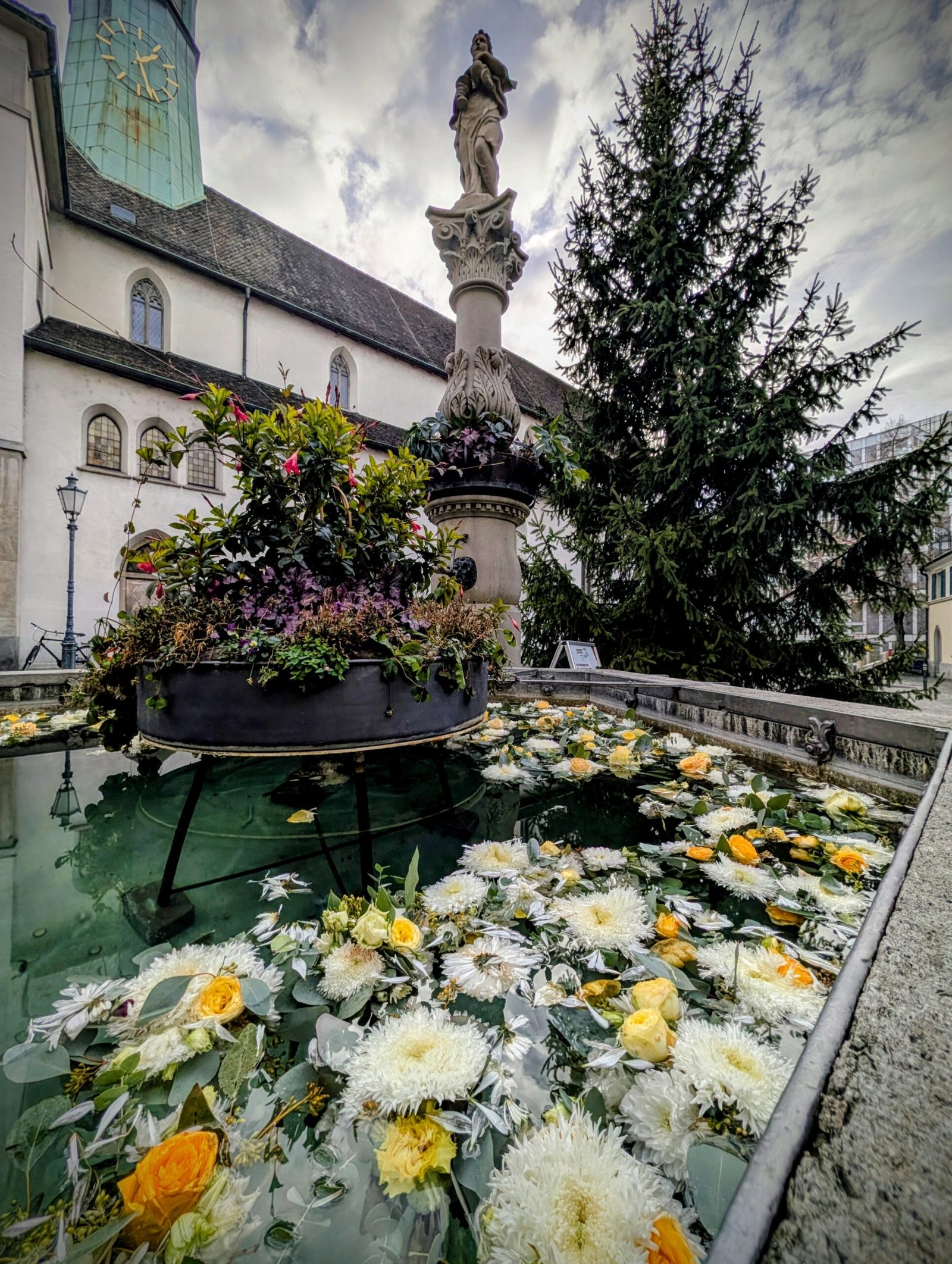
Continuing toward the river, we stopped at Napfbrunnen, a modest stone fountain tucked along a narrow Old Town street. What makes it more interesting is that Zurich is home to more than 1,200 fountains, one of the highest concentrations of public fountains in the world.
Historically, these fountains served as essential sources of drinking water and gathering places for communities. Today, almost all of them still flow with fresh, drinkable spring water, a reminder of how deeply integrated water is into Swiss daily life.
In warmer months, many fountains are decorated with flowers, turning even the smallest squares into colorful pockets of charm. Even in early November, we spotted a fountain in Augustinergasse still blooming with late season flowers, a small but lovely detail that shows how Zurich maintains beauty in every season.
Rathaus
Steps from the water sits the Rathaus, Zurich’s town hall. Built between 1694 and 1698 directly over the Limmat River, its Renaissance architecture and riverfront placement make it impossible to miss and easy to admire.
Grossmünster, Wasserkirche and the Riverfront
One of Zurich’s most iconic landmarks, Grossmünster rises above Old Town with twin Romanesque towers. Legend holds that Charlemagne discovered the graves of Zurich’s patron saints on this hill and ordered the church constructed in their honor.
Nearby stands Wasserkirche, once situated on a small island in the river, which gave it its name, the Water Church. The pairing of the two churches across the river creates one of Zurich’s most photogenic stretches.
Münsterbrücke and Fraumünster
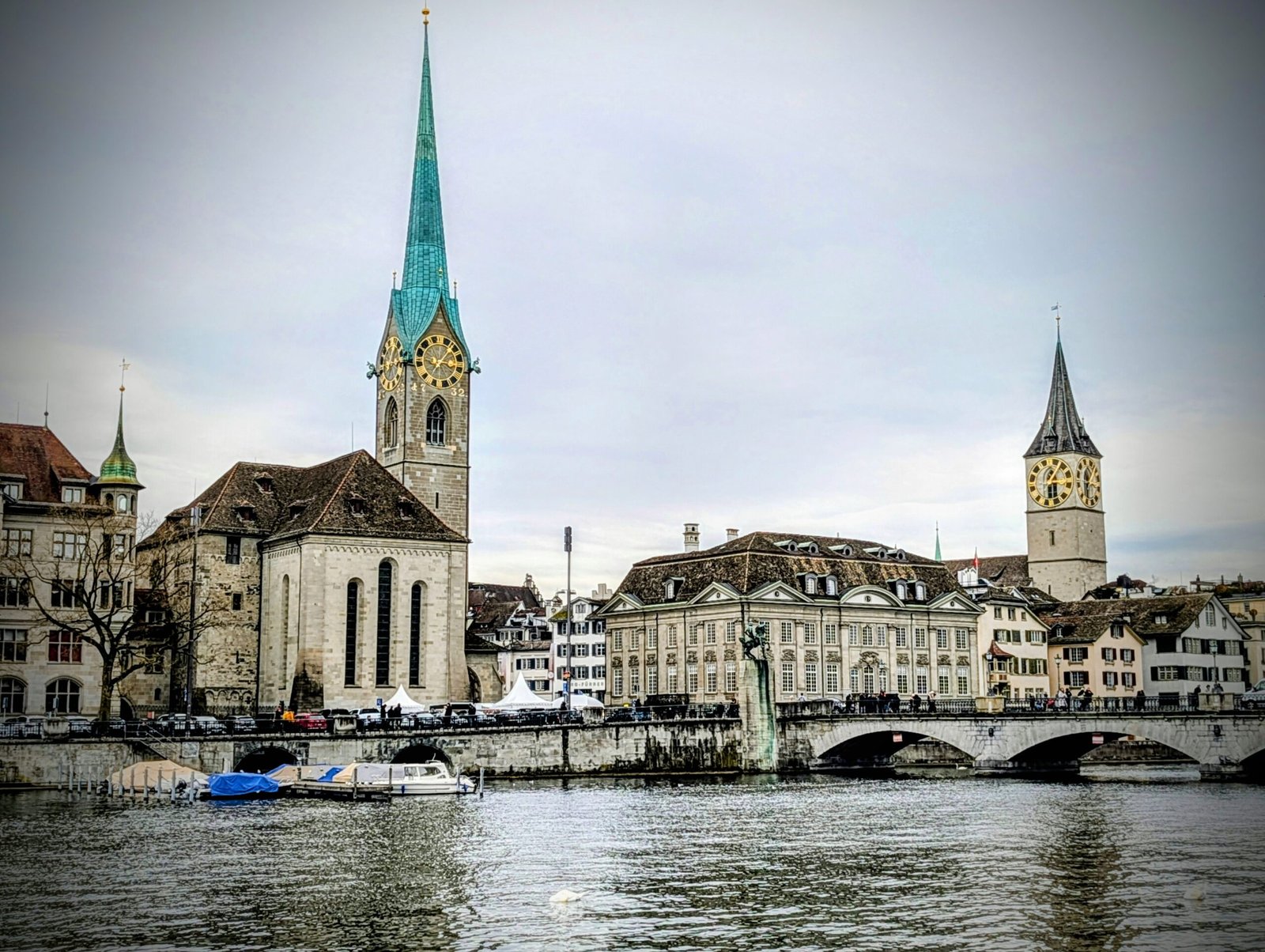
Crossing the Münsterbrücke gives postcard views on both sides. The bridge connects Grossmünster to Fraumünster, known for its iconic slender spire and its world famous stained glass windows by Marc Chagall and Augusto Giacometti. Even a brief visit inside feels like stepping into a jewel box of color.
St. Peter and Augustinergasse
Next we walked to St. Peter, recognizable for having one of the largest church clock faces in Europe. From there, we wandered into Augustinergasse, one of Zurich’s most charming streets. Known for its brightly painted oriel windows, narrow passageways, and decorative lanterns, it feels like walking through a preserved piece of the 16th century.
Ganymede and Lake Zurich
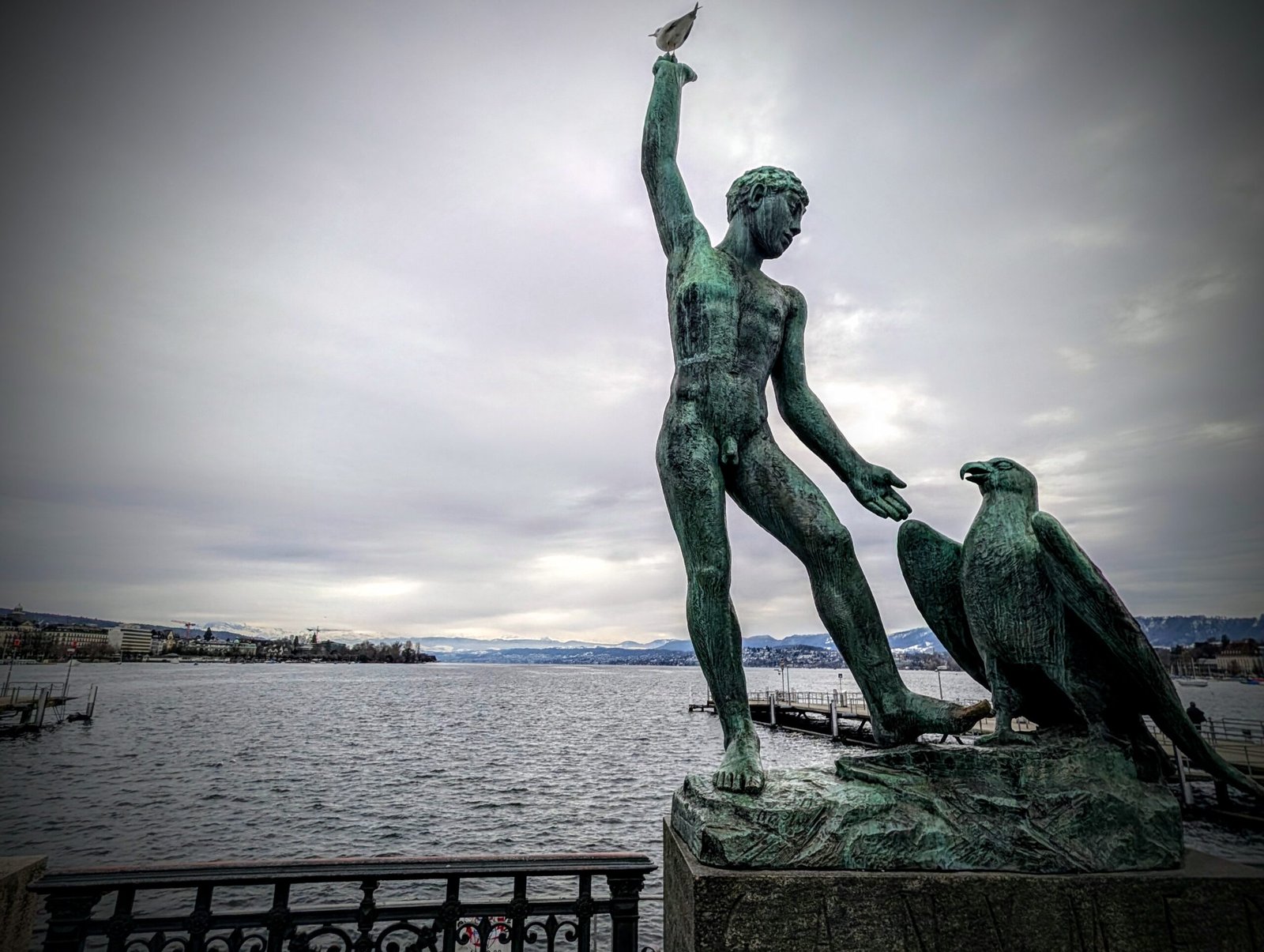
Farther south along the water, the bronze sculpture Ganymede stands dramatically against the backdrop of Lake Zurich. Depicting Zeus as an eagle lifting Ganymede into the heavens, the statue offers a mix of mythology, art, and lakeshore beauty.
Zurich Opera House
Before diving into the markets, we paused at the Zurich Opera House, one of the most celebrated cultural buildings in Switzerland. Its grand exterior and prominent lakeside location make it a landmark even for those who never step inside.
The Christmas Markets of Zurich
Zurich transforms during Advent, filling its plazas and riverfront with markets that blend tradition, crafts, food, and community spirit. While Germany often gets the most credit for Christmas markets, Switzerland shares deeply rooted festive traditions, and Zurich hosts a generous number of significant markets across the city.
Historically, winter markets served as gatherings where artisans, farmers, and families exchanged goods and celebrated the season together. Today they preserve that old world feel with wooden stalls, live music, mulled wine, and seasonal foods like raclette, fondue, roasted chestnuts, and chimney cakes.
Here are the markets we were able to experience during our layover.
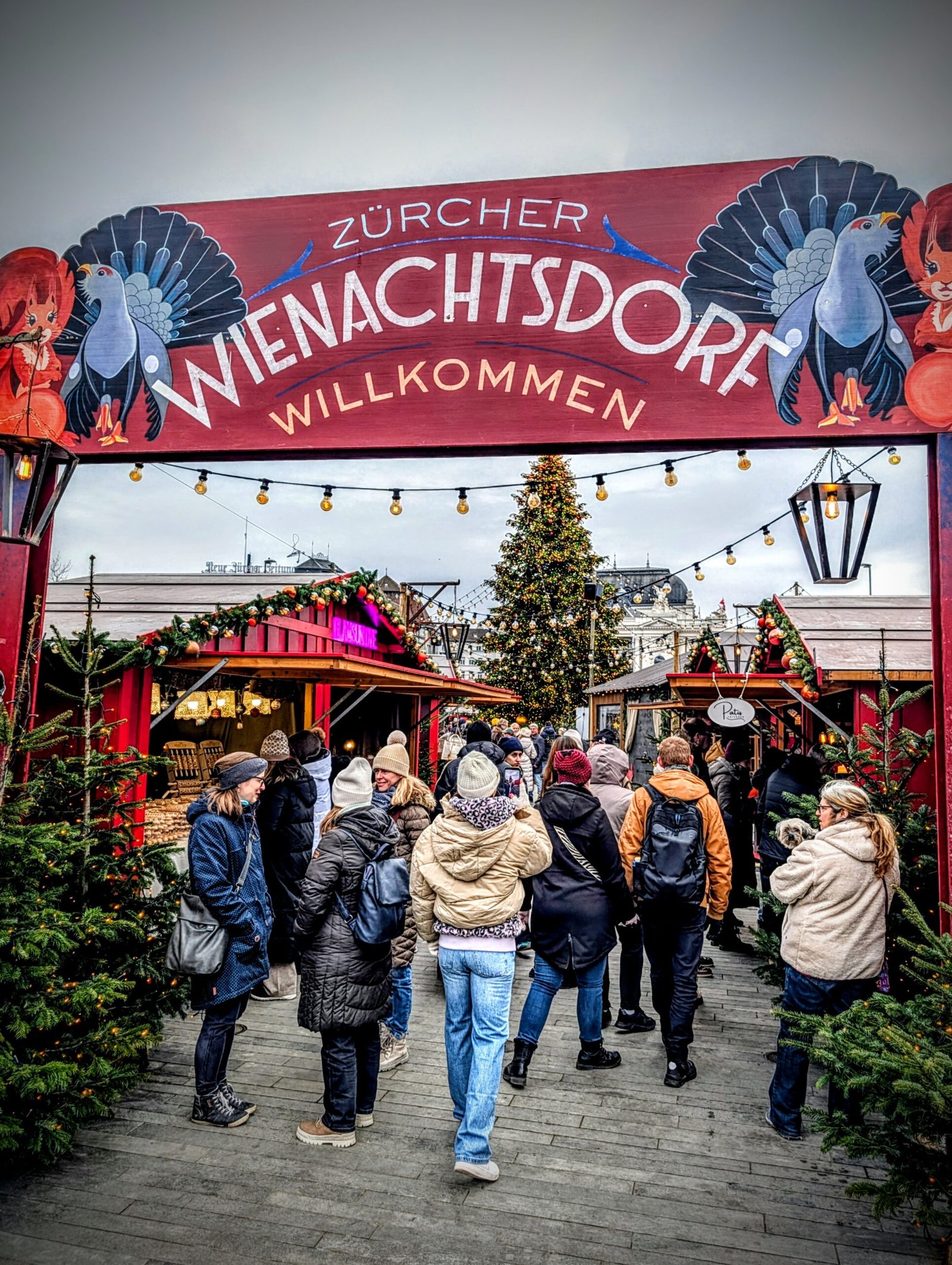
Weihnachtsdorf at the Opera House
The most robust and lively market is Weihnachtsdorf, held at Sechseläutenplatz in front of the Opera House. This village style market has rows of wooden chalets, an ice rink, a towering Christmas tree, and dozens of food stands offering everything from fondue bowls to chimney cakes. It feels festive, bright, and constantly buzzing.
Grossmünster Christmas Market
Smaller and more intimate, the Grossmünster Christmas Market sits near the base of the church, surrounded by Romanesque architecture. This market feels more historic and calm, with handmade goods and a cozy atmosphere tucked among old stone buildings.
Münsterhof Market
Located in one of Zurich’s most elegant squares, the Münsterhof Market emphasizes regional craftsmanship. With Fraumünster’s blue spire towering overhead, this market blends upscale artisan goods with a refined holiday ambiance.
Werdmühleplatz and the Singing Christmas Tree
One of the most unique markets in the city, Werdmühleplatz features the famous Singing Christmas Tree, a tiered, tree shaped stage filled with live choirs who perform throughout the evening. It is festive, charming, and feels especially local.
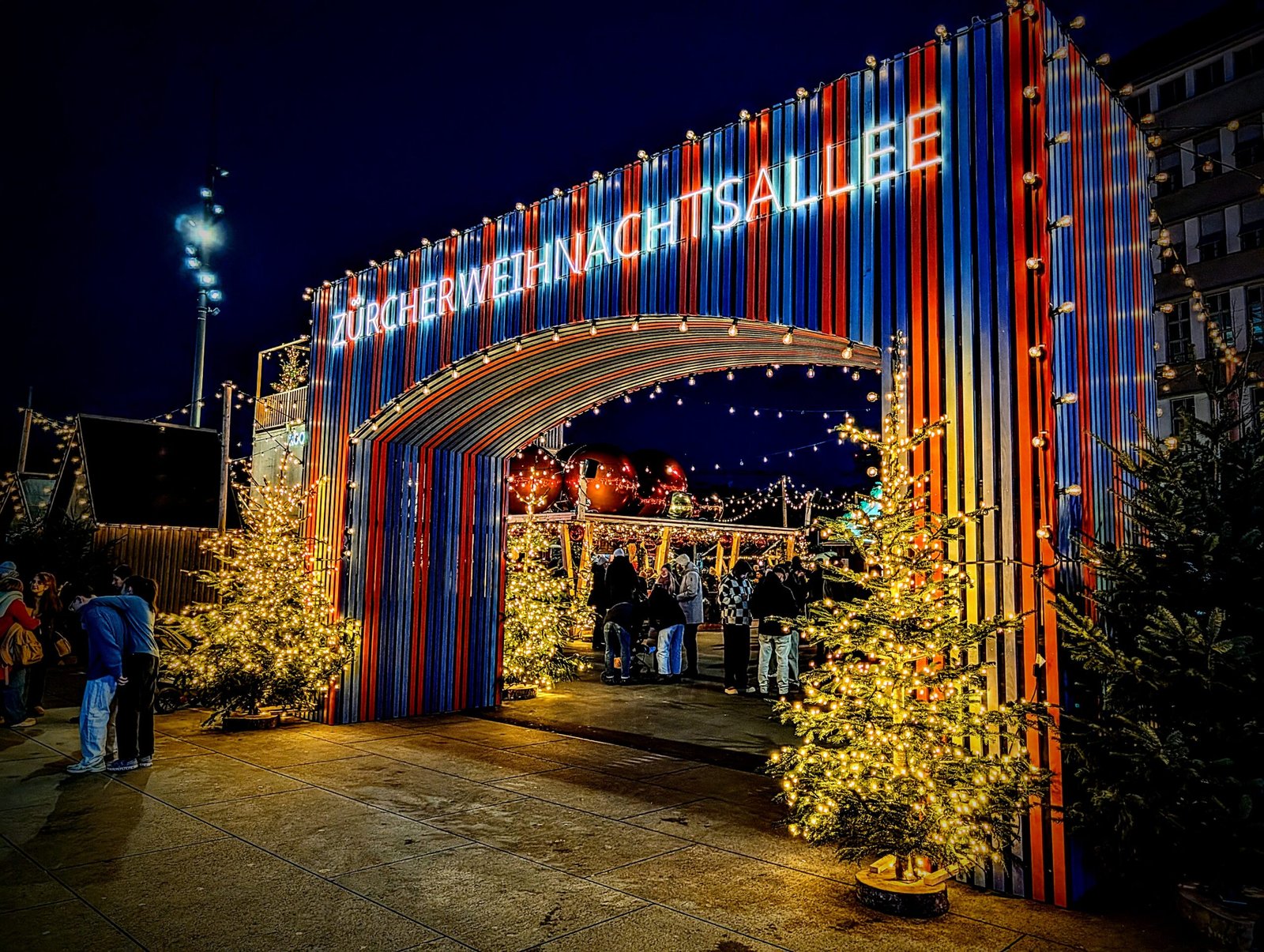
Zürcher Weihnachtsallee at Europaplatz
Right outside Zurich’s main train station is Zürcher Weihnachtsallee, a long, illuminated walkway lined with market stalls at Europaplatz. With commuters, visitors, and locals mingling together, it is one of the most accessible and energetic markets in the city.
What We Missed
Even with a full layover, we did not quite make it to everything.
- Swiss National Museum – this one deserves more time to explore properly.
- Giacometti-Halle – open only Wednesday through Friday. We visited on a Saturday, but hear it is spectacular.
Wrapping Up
Zurich is one of the easiest cities in Europe to explore during a layover thanks to its walkable Old Town and quick airport transit. Add Christmas season into the mix, and the city becomes an unforgettable holiday detour filled with art, history, architecture, and festive cheer.
A layover does not have to be wasted time, it can be a highlight. Step out, walk a little, and let the city surprise you.
Eat Smart. Travel Farther.
Leave a Reply